


From Horses to Horsepower: Bemidji’s First Motor Fire Truck, 1914–1915


The photograph shows Bemidji Fire Department No. 1 standing on a winter street, its front wheels fitted with wooden skis. Two men sit high in the cab, bundled against the cold. The machine looks ready for work, but getting to this moment took nearly a year of debate, testing, and careful decision-making.
Bemidji did not rush into motorized firefighting.
A City Divided
In April 1914, the Bemidji City Council openly disagreed about whether the city should even advertise for bids on an automobile fire truck. Some aldermen believed the city was not ready for such an expense or such a change. Others felt the issue should be explored and objections addressed later. The vote to request bids passed by a single vote, cast by newly appointed Fourth Ward alderman A. W. Ditty.
The fire department supported modernization. Fire Chief Doran formally requested a motor-driven fire truck and asked that the fire committee and department report back on specifications and whether existing equipment could be used in exchange.
This was not a casual request. Fire apparatus in 1914 represented a long-term commitment, and a failure under winter conditions could be catastrophic.
What Firefighting Required in 1914
By the early 1910s, many departments were shifting from horse-drawn wagons to combination chemical and hose motor trucks. These vehicles carried soda-acid chemical tanks for rapid response to small fires and large quantities of hose for hydrant connections or drafting water. Speed mattered, but reliability mattered more.
In Bemidji, winter performance was critical. Snow, rutted streets, sand, and mud were constant obstacles. Horses were proven in those conditions. Motor trucks still had to earn trust.
Selecting the Seagrave Truck
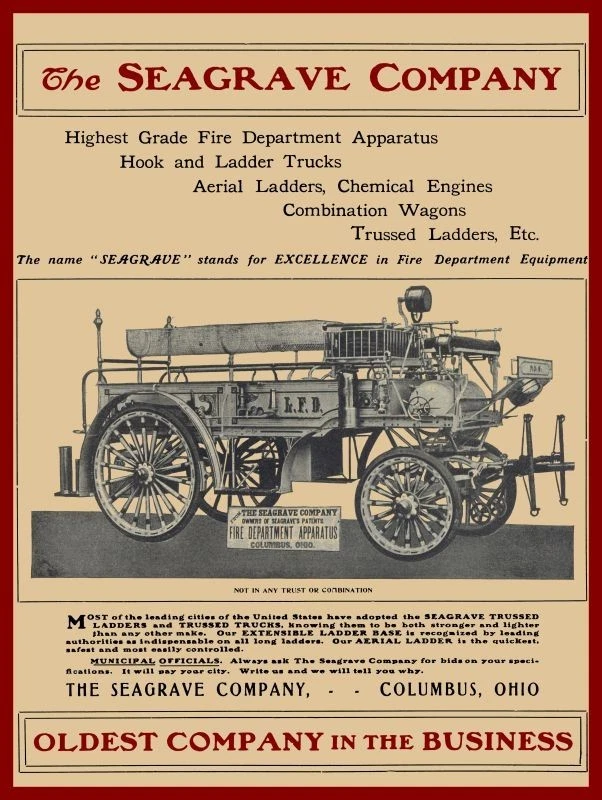
In June 1914, bids were opened for a combination chemical and hose motor fire truck. The Seagrave Company submitted two options. Seagrave was already nationally recognized for purpose-built fire apparatus designed to carry heavy loads of hose, ladders, tools, and chemical tanks.
Even so, the council delayed acceptance and referred the bids back to the fire committee and department. The city wanted evaluation, not enthusiasm. Fortunately for Seagrave, Grand Forks was already operating its motor fire trucks successfully, and a visit and demonstration of that potential won over the reticent council.
Arrival, Testing, and Winter Readiness
Bemidji’s Seagrave truck arrived in early January 1915. Newspaper coverage made clear that it would be fully tested before acceptance. The truck was examined for speed, handling, load capacity, and winter operation.
The specifications were substantial for the period. The truck carried 1,200 feet of hose, fifty gallons of chemical, additional chemical hose, individual extinguishers, ladders of multiple lengths, and a full complement of firefighting tools. Powered by a 75-horsepower engine, it was capable of speeds far beyond a horse-drawn wagon once underway.
The skis visible in the photograph were a practical adaptation, not an experiment. Fire departments across northern states and Canada commonly fitted early motor apparatus with removable wooden skis during the winter months. Skis helped distribute weight and prevented the front wheels from digging into snow, while rear wheels relied on chains or aggressive tread for traction.
Their presence on Bemidji’s truck signals an expectation that the motor apparatus would replace horses entirely, even in deep winter.
Acceptance and a Change in Personnel
On January 19, 1915, after testing and evaluation, the Bemidji City Council formally accepted the Seagrave fire truck at a cost of $5,300.
With that decision came the retirement of Charlie and Major, the horse team that had hauled the city’s fire apparatus in response to City Hall alarms for the previous five years. The city arranged to sell the team, along with their harness and equipment.
Motorized firefighting also required new roles. On March 22, 1915, the city officially appointed G. Brennan and Wm. Gaines as fire truck drivers and janitors of the city building. Mr. Brennan and Mr. Gaines were trained by Robert Browning, a representative from Seagrave, when the truck was first delivered, but did not join the city payroll until two months later. Brennan was assigned the day shift and Gaines the night shift, with the two men alternating monthly.

That appointment marks an important transition. Firefighting in Bemidji was no longer powered solely by feed and muscle. It now depended on trained operators, mechanical knowledge, and routine maintenance - traditions that continue today.
References
Bemidji Daily Pioneer. Minnesota Historical Society, Bemidji Daily Pioneer Collection.
Federal Reserve Bank of Minneapolis. Inflation Calculator. Minneapolis Fed, https://www.minneapolisfed.org/about-us/monetary-policy/inflation-calculator. Accessed 19 Dec. 2025.
Friends of the FWD/Seagrave Museum.“Our History.” FWD/Seagrave Museum, http://www.fwdseagravemuseum.org/ourhistory.html. Accessed 19 Dec. 2025.
Seagrave Fire Apparatus LLC.“History.” Seagrave, https://seagrave.com/Company/History. Accessed 19 Dec. 2025.


Historical stories about early firefighting technology offer a fascinating look at how communities adapted to changing times. The transition from horse-drawn equipment to motor-powered fire trucks was an important step in improving emergency response and modernizing local services. Exploring these developments helps readers appreciate the people and innovations that shaped public safety. On a different note, sports fashion enthusiasts may appreciate the 49ers gold vintage jacket for its classic, nostalgic, and team-inspired style.
Interesting look at how firefighting changed from horse-drawn equipment to motorized trucks. The historical details make the story easy to follow. It also reminded me how much halloween ghostface costume has become part of modern Halloween culture.
Really interesting look at Bemidji’s shift from horse-drawn to motorized fire trucks—it shows how carefully communities once adopted new technology. In a similar way, modern healthcare has evolved thoughtfully, and clinics offering the best physiotherapy Mississauga now combine advanced techniques with proven methods to deliver better results. Great historical insight!
The transition from horse drawn fire engines to motorized trucks must have felt like science fiction to the communities witnessing it firsthand and Bemidji's story captures that moment of change really vividly. 1914 was such a pivotal era where tradition and technology were colliding in almost every public institution simultaneously. At our company which is a leading digital marketing agency in usa we actually find a lot of inspiration in stories like this one because the resistance and eventual adoption of new technology back then mirrors so much of what businesses go through today when modernizing their operations. History really does keep rhyming.
I’ve always enjoyed fashion that feels connected to storytelling. While exploring TV-inspired wardrobes, I noticed Sweet Magnolias 2026 Outfits, which beautifully represent simple elegance and everyday comfort. The style feels warm, authentic, and easy to admire.